
Why the CFO role is expanding, and how data, automation, and middle-office modernization are defining the next era of leadership.
Private markets are experiencing one of the most transformative periods in their history. Capital is shifting. Fund structures are evolving. LP expectations are rising. Technology is accelerating. Regulation is expanding. And operating models that worked for the past 20 years are reaching their breaking point.
At the center of all this change is the CFO.
The Private Funds CFO Insights 2026 report highlights a clear trend:
The CFO role has evolved far beyond financial reporting and compliance. Today’s CFO is a data leader, technology strategist, operational architect, and partner to both the front and back office.
Firms that embrace this evolution are gaining speed, accuracy, and strategic clarity.
Firms that resist it are falling behind.
Why the CFO role is expanding so quickly
1. LP expectations have reached new levels of intensity
LP scrutiny is rising across all categories – performance, valuations, fees, governance, cybersecurity, and operational controls. CFOs must now be prepared to answer highly granular questions about:
- Data lineage
- Reporting accuracy
- Controls and governance
- Middle-office processes
- Operating infrastructure
- Transparency and standardization
This requires deep visibility across the entire organization – not just finance.
2. Fund structures are more complex than ever
CFOs are now expected to oversee:
- Evergreen NAV cycles
- Semi-liquid and private wealth strategies
- SMAs and feeders
- NAV loans and hybrid facilities
- Multi-vehicle data consolidation
Each structure adds friction and increases the operational and reporting demands on the CFO office.
3. Data complexity has reached a tipping point
The CFO report makes it clear: firms are drowning in inconsistent, unstructured data arriving from PMCs, internal spreadsheets, valuation models, accounting systems, and third parties.
The CFO is now responsible for turning that chaos into reliable, actionable information.
4. AI and automation initiatives depend on CFO leadership
CFOs know AI can transform reporting, forecasting, and operations – but AI requires clean, consistently structured data, something only the CFO’s office can steward.
5. Technology strategy is now part of the job description
When systems don’t talk to each other, reporting breaks down.
When processes remain manual, errors multiply.
When data is siloed, decisions slow.
CFOs increasingly own the systems, integrations, data architecture, and operating models that power the firm.
The Modern Private Markets CFO Must Lead Across Four Dimensions
1. Financial Leader
This is the traditional core: performance reporting, budgeting, forecasting, cash management, valuation support, audit, tax, and compliance.
2. Data Steward
CFOs must ensure data is:
- Accurate
- Standardized
- Governed
- Traceable
- Centralized
Without this, reporting and analytics fail.
3. Technology Strategist
CFOs now evaluate:
- Platform consolidation
- Data integration
- Reporting automation
- AI readiness
- Workflow efficiency
- System-of-record vs. system-of-intelligence architecture
The CFO is becoming the executive responsible for technical scalability.
4. Operational Architect
CFOs design and optimize the firm’s:
- Middle-office processes
- Fund finance workflows
- Evergreen and private wealth operations
- Reporting cycles
- Valuation processes
This is where the biggest performance gains are realized.
Why Traditional Tools Can’t Support the Modern CFO
Many firms still rely on:
- Spreadsheets held together with complex formulas
- Manual reporting packages rebuilt every quarter
- Disconnected accounting, asset, and debt systems
- Google Drive / SharePoint as “data infrastructure”
- Versioning confusion across teams
- Slow, reactive processes instead of proactive workflows
These tools don’t scale – and they don’t give CFOs the visibility or control they need.
The modern CFO needs:
- A unified platform
- A single source of truth
- Automated data ingestion
- Standardized COA and data structures
- Real-time reporting
- Embedded analytics
- Strong governance controls
- Fund-to-lease (and fund-to-loan) visibility
This is the operational backbone the next generation of CFOs will lead with.
How Pereview supports the modern CFO’s expanded role
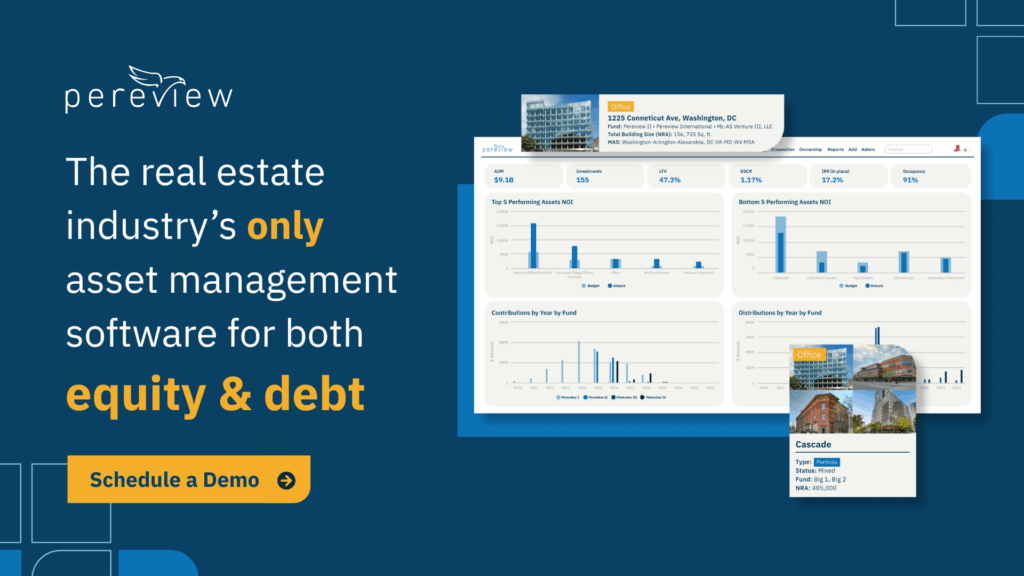
Pereview delivers the data discipline, system consolidation, automation, and insight infrastructure that CFOs now require.
1. A Single Source of Truth Across the Entire Investment Lifecycle
Asset data, fund data, debt data, investor data – all centralized and reconciled.
2. AI-Powered Ingestion
PMC files, internal models, and third-party data are automatically classified, mapped, validated, and structured.
3. Automated Reporting
ILPA templates, performance reports, exposure rollups, cash flows, waterfalls – produced without rebuilding spreadsheets.
4. Real-Time Dashboards
Embedded Power BI delivers immediate visibility into:
- NAV
- Liquidity
- Exposure
- Tenants
- Markets
- Debt metrics
- Performance trends
5. Stronger Controls & Auditability
Every number has lineage, every workflow has guardrails, every assumption is trackable.
6. Scalable Operating Model for Any Fund Structure
Closed-end, evergreen, SMA, feeder, private wealth – Pereview supports all with unified data.
This is the platform that turns the CFO into a strategic operator with real-time intelligence rather than backward-looking reporting.
The CFO role has evolved – and so must the infrastructure behind it
The modern CFO cannot lead effectively with legacy tools or siloed systems.
- Private markets are becoming more complex.
- LPs are becoming more demanding.
- Funds are becoming more diverse.
- Regulators are becoming more active.
- AI is becoming more powerful.
To meet the moment, CFOs need:
✔ Reliable data
✔ Automated processes
✔ Real-time insights
✔ Scalable systems
✔ A modern middle office
And Pereview is the operating system that enables it.