
Why private markets firms are rethinking their operating models – and how a unified data platform unlocks new efficiency, transparency, and scale
For decades, private markets firms have treated the middle office as a back-of-house function: necessary, operational, and largely invisible. But that playbook no longer works. As the Private Funds CFO Insights 2026 report makes clear, the middle office has become one of the most important tools firms have to improve performance, accelerate reporting, manage risk, and meet rising LP expectations.
Modern CFOs now see the middle office as a strategic asset, not a support function.
Why? Because the trends and forces reshaping private markets don’t start out in investment committees. They first show up in the workflows that sit between the investment team, asset managers, fund accountants, and investor relations. Those forces include:
- Rising LP scrutiny
- Growing data complexity
- Demand for real-time performance visibility
- Operational challenges from evergreen and private wealth strategies
- AI and automation initiatives requiring clean, centralized data
- More sophisticated fund finance structures
- Increased regulatory and cybersecurity expectations
Each of these pressures lands squarely on the middle office. And firms that modernize this part of the business are seeing a meaningful competitive advantage emerge: Faster execution, higher reporting accuracy, fewer manual cycles, and the ability to scale without proportional headcount growth.
Why the middle office is having a moment
1. Reporting cycles are compressing
LPs expect more granular reporting, more frequently, and they’re asking for custom data cuts along the way. Middle-office teams are now responsible for preparing, reconciling, validating, and distributing data for:
- Fund performance
- Benchmarks
- Exposure analysis
- Valuation support
- Budget vs. actuals
- Cash flow management
- Debt obligations
- Investor-level transparency
This volume of work is impossible to maintain manually. Automation and structured data are now mandatory.
2. Evergreen and private wealth funds need operational muscle
Monthly and/or weekly NAV cycles, rolling subscriptions, and liquidity modeling all rely on timely, accurate, standardized data. Middle-office teams must orchestrate valuation, cash management, and reporting workflows at a pace previously unseen in traditional closed-end structures.
3. Fund finance requires real-time insights
NAV loans, hybrids, subscription lines, credit alternatives, and more – these structures require accurate, always-on data about:
- Asset values
- Cash flows
- Leverage
- Performance
- Liquidity
Middle-office teams hold the keys to the data lenders require.
4. AI readiness begins with data standardization
The report finds that while firms are eager to adopt AI, data consistency is the #1 barrier. Middle-office teams are responsible for the data foundation needed for:
- Automated reporting
- Document classification
- Variance analysis
- Forecasting
- Portfolio analytics
- Investor Q&A support
AI is only as strong as the data feeding it, and that data lives in the middle office.
5. LP due diligence is now operational
CFOs report increasingly detailed LP questions about their operating model: data integrity, controls, governance, cybersecurity, valuation processes, outsourcing, and reporting capabilities.
LPs no longer evaluate performance alone – they evaluate operations.
The challenge: Most middle offices aren’t built for this
Even top-tier firms struggle with:
- Multiple, disconnected systems
- Manual ingestion of PMC files
- Excel-based reconciliations
- Slow valuation support workflows
- Frequent reporting revisions
- Version control issues
- Wasted hours hunting for missing or inconsistent data
- Inability to see real-time exposures across debt and equity
- Difficulty supporting new fund structures
These legacy workflows don’t scale – and they definitely don’t support the level of transparency and speed LPs
The opportunity: A modern middle office powered by unified data
This is where leading CFOs are heading: A single platform that consolidates data, automates workflows, and standardizes reporting across the entire investment lifecycle.
A modernized middle office can deliver:
- Automated reporting (ILPA, variance, exposure, fund performance)
- Standardized COA and consistent data structures
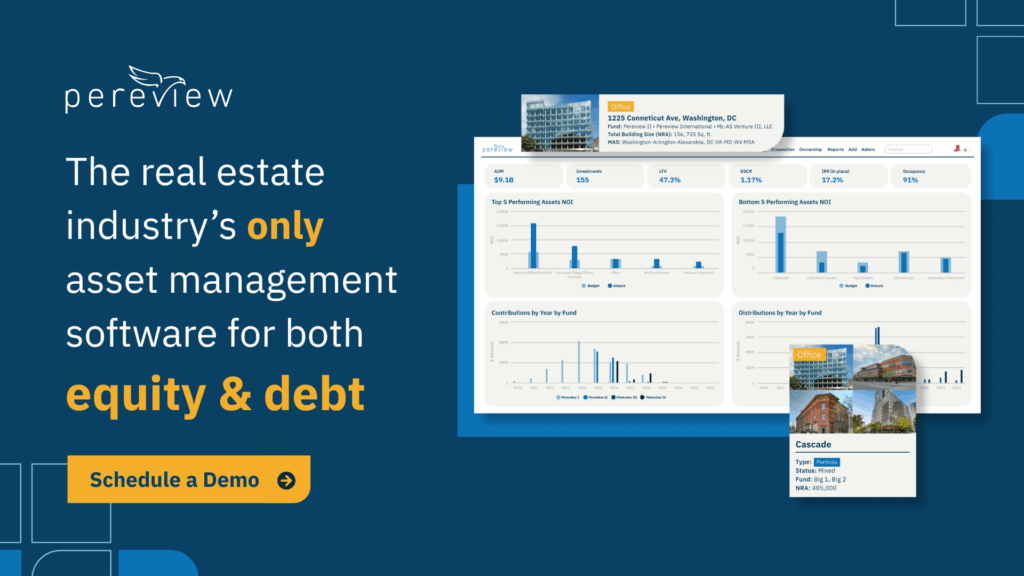
- Real-time dashboards for fund, asset, portfolio, and debt performance
- Faster valuation cycles
- Seamless support for evergreen and private wealth funds
- Automated ingestion and mapping of PMC and internal files
- High-confidence data for investor relations, lenders, and auditors
- The data foundation required for AI
This shift unlocks something powerful: CFOs can spend less time reconciling and more time strategizing.
How Pereview modernizes the middle office
Pereview serves as the system of record and system of intelligence for private markets firms – enabling a modern middle office that is faster, more accurate, and built for scale.
1. One source of truth across debt and equity
All asset-level, fund-level, and investor data lives in one platform, eliminating the reconciliation and version-control problems that slow teams down.
2. AI-powered ingestion and data standardization
Pereview converts inconsistent source files into structured, mapped, validated data – ready for reporting and analysis.
3. Automated reporting at scale
Templates for ILPA statements, variance analysis, exposure reports, cash flows, and performance metrics can be generated automatically.
4. Ad hoc reporting with Power BI for real-time insights
Teams get interactive dashboards that update as data flows in – no re-building spreadsheets required.
5. Support for any fund structure
Closed-end, evergreen, SMA, feeder, private wealth – Pereview handles the complexity and consolidates results instantly.
6. Built-in governance, auditability, and controls
Every number has a documented source, every process has safeguards, and every report is reproducible.
The result is a middle office that is strategic, resilient, and capable of supporting the firm’s next stage of growth.
Summing it all up
The CFO role is expanding. LP expectations are rising. Fund structures are diversifying.
AI is accelerating. And firms that convert their middle office into a modern, automated, data-driven function will lead the next era of private markets.
The ones that don’t will fall behind quickly.
Pereview is the operating system for the modern middle office – built to unify data, automate reporting, and give CFOs the confidence to scale.