
In the third post of our 2026 Asset Manager Challenges series, we’re taking a closer look at the painful, time‑consuming process of manually consolidating and standardizing property management data and how to transform it with AI.
Private equity real estate fund managers who are not vertically integrated often receive rent rolls and trial balances from property management companies via email as PDF or Excel file attachments. This immediately creates a data bottleneck requiring Asset Managers to stop their day and start downloading reports, open them individually, and manually update their Excel models. Then comes the task of manually mapping data from these documents to the fund manager’s models for various Property Management Companies (PMCs), each with its own chart of accounts. Additionally, PMCs frequently make prior period adjustments without communicating those changes. This process becomes exponentially more complex when investors have multiple properties managed by multiple PMCs.
So, before Asset Managers can analyze anything, they spend hours or even days entering data. AI data ingestion can automate this step, and Pereview’s asset management software can take it a step further by instantly updating the business-level, fund-level, and asset-level financial reports in minutes.
Watch the summary video here:
Standardize the data before you standardize the reporting
If reporting is always a scramble, the fix usually isn’t “build a better report.”
The fix is to standardize the underlying data so every downstream view – budget vs. actuals, variance analysis, trend lines, portfolio rollups – can be produced consistently without starting from scratch each month.
At a practical level, that means creating a consistent approach to three things:

1. Ingest data in whatever form it arrives
Because PMCs likely won’t change their processes for you, the workflow has to handle:
- Excel files, PDFs, exports, and templates
- Varying levels of detail
- Multi-property packages
- Updates and prior-period adjustments
And it’s not just the format that changes. The content changes too. Rent rolls, trial balances, operating statements, and supplemental reports all arrive in different shapes at different times, depending on the property manager, market, and system they use.
This is where flexible ingestion matters. Instead of relying on a single template, AI can help interpret incoming files, identify fields, and reduce the manual effort required to make the data usable every month.
2. Classify and map into a common structure
This is the part most teams do manually. You need a repeatable way to translate PMC-specific categories into a standardized structure so “R&M,” “Repairs,” and “Maintenance – General” all land where they belong, consistently, every month – so variance analysis isn’t a debate about definitions
This applies across financials and rent roll data. If you can’t normalize those inputs, comparisons break down quickly, especially when you’re trying to view operating performance and leasing health together (occupancy, delinquencies, expirations, concessions) alongside the P&L.
AI can also help accelerate this step by recognizing recurring categories and supporting a more consistent mapping process across files and property managers.
3. Validate and preserve trust in the numbers
Standardizing data can’t mean “force it until it fits.”
You need controls that ensure:
- Totals tie out
- Exceptions are flagged
- Adjustments don’t break comparability
- Changes are tracked
- Adjustments don’t break comparability
The goal is a repeatable process with an audit trail so teams can explain what changed and why, then spend less time updating reporting data and more time acting on performance. By identifying and normalizing data at ingestion, AI can reduce the volume of manual cleanup before validation and review.
Where Pereview fits
Streamlining this process with AI is the best approach, but this is not something you can easily do on your own. That’s why Pereview’s product development team took on the step of building AI functionality into its asset management software to solve the time-consuming step of getting all your commercial real estate data into one platform – even if it’s coming from third-party property management companies.
Pereview’s founder, Jeff Wilson, explains how Pereview is delivering on this promise in his video The Power of Pereview Part 6: AI and Automation in CRE Asset Management. Watch it now by simply clicking here or on the image below.

How AI-driven data ingestion helps
Pereview’s AI data ingestion can identify incoming rent rolls even when formats vary, extract and structure financial information so your Excel models used for common financial reports are instantly updated.
With this standardized data in place, asset managers can:
- Compare budget vs. actuals quickly across the portfolio
- Identify and isolate variances earlier (before they become quarterly surprises)
- Connect operational signals (like occupancy, delinquency, lease rollovers) with financial performance
- Shift time away from data cleanup and toward performance decisions
The goal isn’t just “clean data.” It’s faster visibility, more confidence in what you’re seeing, and more time spent driving outcomes. This is where standardization and AI ingestion pay off.
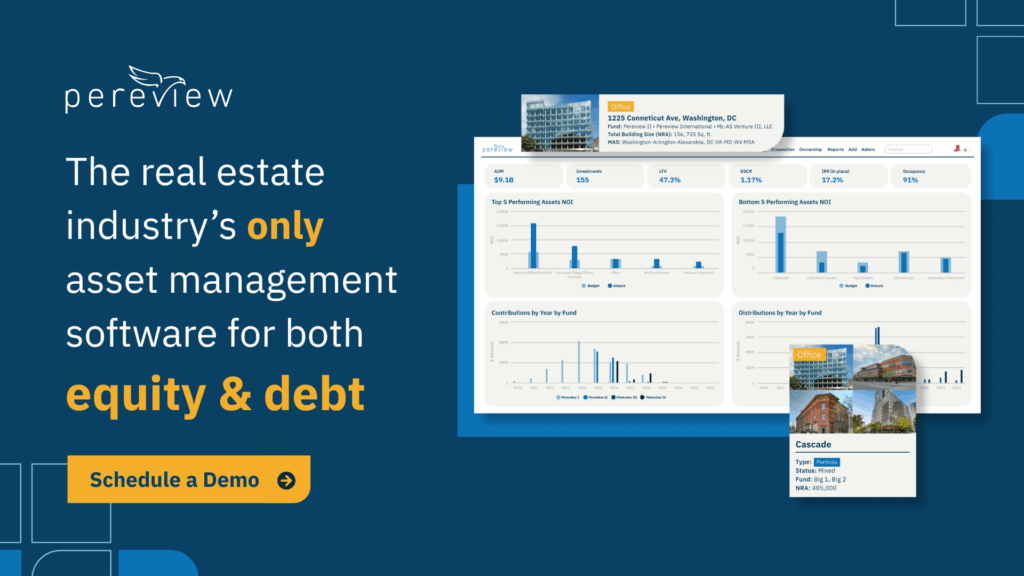
Insert demo graphic from prospect emails ng, and more time spent driving outcomes. This is where standardization and AI ingestion pay off.