
In the first post of our 2026 Asset Manager Challenges series, we address one of the most common and time-consuming issues: manually updating reports.
Reporting should be a simple process, but it can quickly turn into a days- or weeks-long scavenger hunt: chasing down Property Management Companies (PMCs) for trial balances and rent rolls from a variety of source systems like Yardi, MRI, RealPage OneSite, or others, and manually updating Excel models for the current period so you can compare against prior periods.
For private equity real estate funds, timely and accurate reporting is critical. When accuracy depends on manual data entry, decision-making slows—and performance can suffer.
This time-consuming effort is relentless, leaving high-value professionals spending hours performing low-value administrative tasks rather than managing risk and driving NOI growth across the portfolio.
Watch the summary video here:
Manual reporting is error-prone and risky, not just an efficiency issue
Manual reporting is often framed as a productivity problem. In reality, it is a structural risk inside the asset management function. Here is how it typically manifests:
- Variances get missed or show up too late to act. When the task is to “collect, consolidate, and update” a tear sheet variance may be identified too late to correct, which can cost NOI performance.
- Asset and portfolio reviews become reactive. Instead of discussing what to do next – renewals, capex timing, leasing strategy, expense controls – the conversation turns into a time-consuming replay of what happened last month and why the numbers changed.
- Tracking asset performance begins to feel chaotic. This often happens. Accurately tracking asset performance can begin to feel chaotic when prior period adjustments are not monitored systematically. Property management companies frequently post adjustments for late invoices, accrual true-ups, revenue corrections, or reclassifications. While each individual adjustment may be explainable, the risk arises when they are not tracked cumulatively over time.
- If prior period adjustments are only reviewed at the monthly level and not analyzed on a rolling basis, performance trends can become distorted. A one-time $25,000 adjustment may be immaterial in isolation, but if similar adjustments occur repeatedly over six months, the cumulative $150,000 impact may signal a structural accounting or operational issue rather than a one-off correction.
- Without a trailing view, recurring adjustments can appear episodic instead of systemic – obscuring true run-rate NOI and weakening forecasting accuracy.
- Private equity real estate funds that use third-party Property Management Companies (PMCs) to manage their assets face a more complex process. Each PMC has a different accounting system (Yardi, MRI, RealPage OneSite, AppFolio or another), and every chart of accounts is different. Thus, the process of updating internal models takes asset managers longer. Teams don’t just lose time; they open themselves up to risk associated with this error-prone process around critical numbers, and that slows decision-making.
If any of that feels familiar, it’s because most firms are trying to solve a data problem with more manual effort. But there’s a better approach.

The better approach? Structured real estate data
The answer isn’t adding more people to speed up manual Excel updates. It’s building a foundation where the data is structured consistently, so reporting becomes automated.
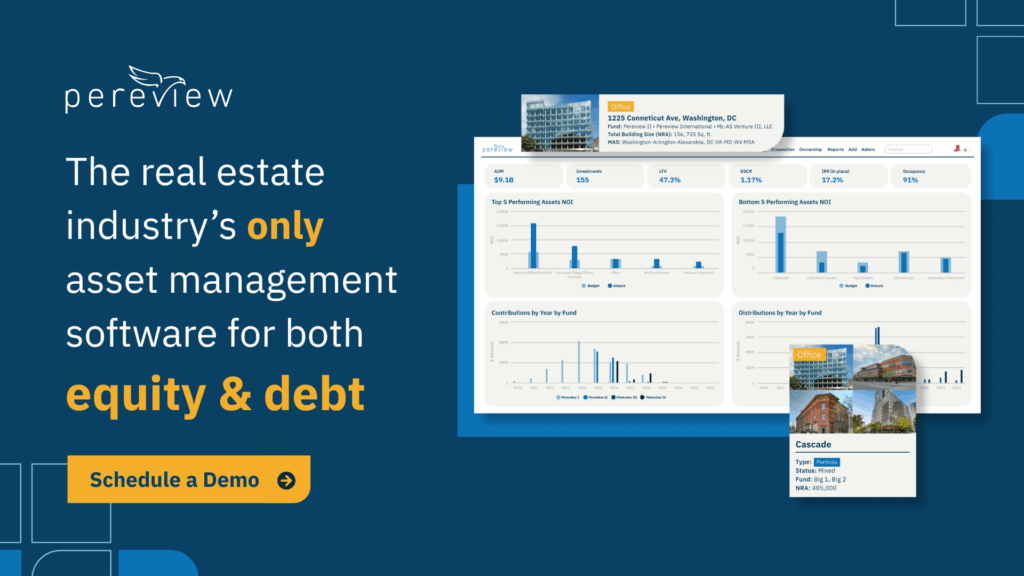
In practice, that means standardizing data, so the same KPI means the same thing, property to property, and teams can rely on automatically updated reporting data with an asset management software platform like Pereview Enterprise.

Where the Pereview asset management software fits
Pereview Enterprise was built to address this problem. By centralizing data and automating reporting processes, the software helps teams shift how they spend their time, moving away from manually updating dozens of cells across Excel spreadsheets and toward the work that drives results: protecting cash flow, executing the business plan, and driving NOI.
Here are four key business outcomes Pereview Enterprise clients realize:
- Automated data updates for reports, no more manual data entry
- Standardization of definition and the math behind key KPIs like NOI, occupancy, delinquency, leasing, and more
- Executive and Investor Committee meetings become less about what happened and more about the future strategic business plan
- Reclaim up to 90% of the time previously spent on manual updates — resulting in less time defending numbers and more time acting on them
“Pereview’s platform frees up employee bandwidth, allowing us to focus on creating value for our tenants. The consolidation of data will dramatically reduce the time required to find information, resulting in resource savings that we can use to focus on expansion.”
Jon Lewin, CEO, MedCraft Investment Partners
This is the real shift: reporting moves from a manual bottleneck to a reliable operating foundation for asset management. That means less time spent updating spreadsheets and defending numbers, and more time spent protecting cash flow, managing risk, and driving NOI.