Why CFOs see AI as a competitive advantage – and why data readiness is the barrier holding most firms back
Artificial intelligence has entered private markets with remarkable speed.
It’s in nearly every strategic plan, every board conversation, every operating committee meeting. Yet despite the momentum, the Private Funds CFO Insights 2026 report reveals something striking:
Not a single CFO surveyed believes their firm is leading with AI innovation.
That’s not hesitation – it’s a recognition that while AI’s potential is massive, the private markets ecosystem simply wasn’t built for it. Disparate systems, inconsistent files from PMCs, unstructured Excel models, and manual reporting cycles all work against AI’s strengths.
Firms are excited and they’re experimenting. But most firms aren’t ready.
In fact, the report shows that while 64% of CFOs are piloting or implementing AI use cases, data quality, availability, and structure are the top barriers to adoption – far ahead of cost or security concerns.
And that’s the story we’re living through: AI will transform private markets, but only for firms with the data foundation to support it.
CFOs are exploring AI – carefully
The report shows a clear adoption curve:
- 8% not yet exploring AI
- 29% in early exploration
- 36% piloting use cases
- 25% actively implementing
- 2% say AI is fully embedded
That’s an incredibly fast curve for an industry known for conservatism.
Where CFOs are focusing first:
1. Document summarization and review
AI is helping teams review contracts, financials, and due diligence packages at scale.
2. Due diligence questionnaires and investor request support
CFOs are using generative tools to draft responses – but only once they’ve verified the data manually.
3. Policy and procedure review
AI is helping summarize audits, regulatory updates, and internal controls.
4. Workflow automation
Several CFOs in the report cite early wins from AI-enabled tools that smooth out internal reviews and approvals.
These are meaningful – but they’re also the easy wins. The next stage is far more transformative.
The real prize: AI that understands the firm’s data
CFOs agree that the most valuable, long-term use cases for AI lie in:
- Performance analysis
- Forecasting
- Real-time investor reporting
- Automated reconciliation
- Insights across multiple funds, assets, tenants, and markets
- Predictive risk modeling
- Automated underwriting checks
- Portfolio-level “what if” scenarios
But here’s the catch: AI can’t do any of this unless the underlying data is clean, structured, and consistently mapped. Most private markets firms simply don’t have that today.
This is why so many CFOs in the report stress the need to build a data foundation before expanding their AI strategy. As one CFO summarized, “You cannot automate analytics when every source file looks different.”
Disorganized data is the #1 barrier to AI adoption
The report highlights the primary blockers:
- Unclear use cases or ROI
- Lack of internal expertise
- Security and compliance concerns
- Data quality and availability (the most cited barrier)
Private markets firms are drowning in unstructured data:
- 10–20 file types from PMCs
- Excel models using different structures
- Accounting data with different COAs
- Siloed asset, fund, and debt systems
- Documents arriving in PDF, Word, and image formats
- Ad hoc reporting spreadsheets everywhere
AI can help process this, but only after the firm establishes a consistent system of record.
Otherwise, AI becomes another disconnected tool – unable to reason, reconcile, or automate.
AI without data discipline = faster mistakes
This is the risk CFOs understand intuitively. AI amplifies the quality of the inputs it receives.
If the data is clean, AI becomes a powerful accelerator. If the data is inconsistent, AI becomes a fast, confident source of error.
Which is why modern CFOs are taking a step back and focusing first on data architecture, governance, and standardization.
How Pereview gets firms AI-ready
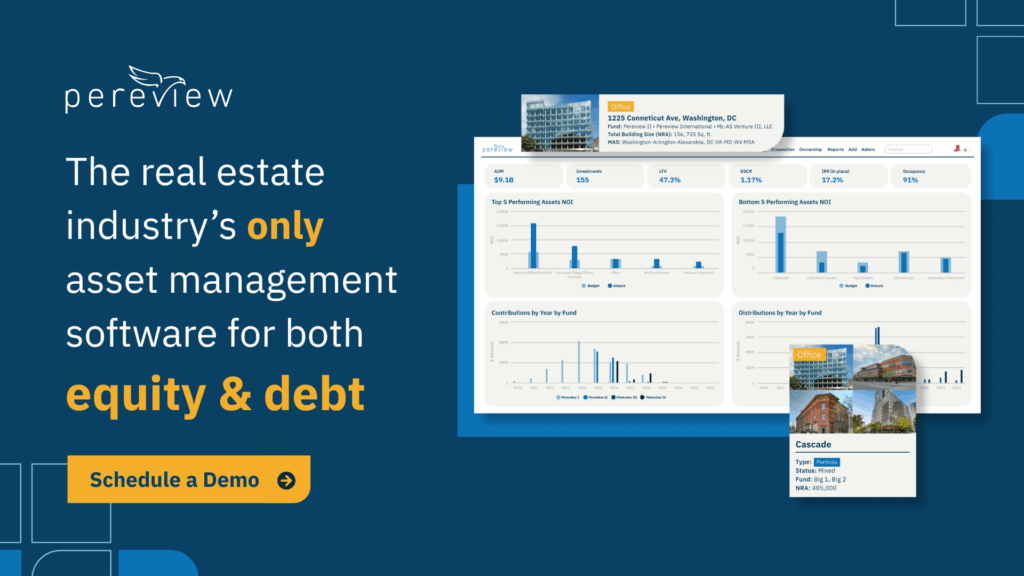
Pereview doesn’t just add AI into workflows – it creates the foundation that makes AI possible.
Here’s how:
AI-Powered ingestion
Automatically reads, classifies, and maps PMC files and internal spreadsheets – removing the manual work that slows down asset and portfolio teams.
Standardized COA and data structures
Ensures asset, fund, and debt data land in the right place every time – no more rework.
Single source of truth across the entire lifecycle
Asset data, fund data, equity, debt, budget vs. actuals, underwriting comparisons, valuations – all consolidated in one platform ready for automated analysis.
AI-ready data lake
Once the data is clean and structured, firms unlock the ability to automate reporting, forecasting, scenario modeling, and investor queries.
Embedded BI and analytics
Teams gain the power to explore data and build insights without fear of conflicting numbers or outdated files.
Pereview doesn’t just help firms experiment with AI – it prepares them to scale it.
AI will transform private markets – but only for firms who prepare their data
The industry is moving quickly. LP expectations are rising, reporting cycles are compressing, and competition for capital is shifting to operational excellence.
AI will separate the firms that lead from the firms that lag, but only if the data is ready.
And Pereview is the platform that creates the clean, centralized data foundation private markets firms need to finally harness the full power of automation and AI.