
By Jeff Wilson, Founder & CEO, Pereview Software
I’ve spent nearly two decades in commercial real estate, and I’ve spent the last several building Pereview around one conviction: a firm’s data and its alpha are the same thing, and neither one should ever leave the building.
Here’s the thing. Lately I keep having the same conversation with customers and prospects, and it always starts the same way. Someone tells me, “We have an enterprise agreement with OpenAI, or Anthropic, that protects our data.” So, I ask what’s actually in that agreement. And that’s usually when the conversation gets uncomfortable.
So, let’s dig in, because I think it’s worth talking plainly about what’s actually happening. Enterprises are spending real money on frontier AI tools and, in return, seeing an uneven return on that spend. Meanwhile, the labs behind those tools are in a position to see exactly which use cases are working on top of their models — and then go build a competing product in that category. That’s not speculation anymore. It’s becoming a documented pattern. And it’s exactly why I want to talk about what AI safety actually means for a firm like ours, and for the real estate investment management firms we serve.
The Warning Bell Already Rang
Palantir CEO Alex Karp has been more direct about this than almost anyone else in the industry. Speaking on CNBC, he made the point that handing a popular LLM provider broad access to your data hands over your existing winning plays — and the means to build the next ones. One line of his has stuck with me: enterprises are wasting their time and their budget on tokens, while the model providers walk away with the IP.
Karp is tapping into something real here. Mid-size and large enterprises want control over their data stack, their alpha, their proprietary knowledge, their trade secrets, and their customer data. And more and more, they’re worried — rightly, I think — about handing those things over to a handful of model providers who may eventually decide to compete with them directly.
This Isn’t Hypothetical. It’s Already Happened.
Let’s look at what happened between Anthropic and Figma. According to reporting from The Information, Anthropic launched Claude Design — a tool that competes directly with Figma’s core product — while Anthropic’s Chief Product Officer was still sitting on Figma’s board. He didn’t resign until three days before the launch. David Sacks talked about this on a recent All-In Podcast episode, and he noted that Figma’s founder said Anthropic hadn’t been fully transparent with them throughout the partnership.
And Claude Design isn’t an isolated incident. Anthropic has also released Claude Legal, Claude Financial, Claude Science, Claude Security, and Claude Code — each one arriving after enterprise customers had already built real usage and real value on top of Anthropic’s models. Claude Code is a clear example. Cursor was first to build a coding assistant on top of the underlying models, and they built a thriving business doing it. Anthropic watched that category perform and then launched a competing product of its own.
Anthropic has also gone directly to life sciences companies, asking them to sign NDAs and share proprietary data to help build a life-sciences-specific model, in exchange for early access. A number of those companies — having spent tens of billions of dollars building and refining their own proprietary data — said no. They recognized that handing it over would commoditize the very thing that made them competitive.
Here’s a related example, even though the mechanism is a little different. Apple has sued OpenAI, alleging that OpenAI and several former Apple employees coordinated to obtain Apple’s confidential hardware technology in support of OpenAI’s own consumer device ambitions — that’s according to reporting from Bloomberg and 9to5Mac. And Apple and OpenAI had an existing strategic business relationship at the time.
This Is an Old Playbook, Not a New One
None of this is new for large technology companies, if we’re honest. Microsoft used its dominance at the desktop operating system layer to push competitors out of the application layer — think Lotus 1-2-3, WordPerfect. Google did something similar, leveraging its dominance in search. What’s happening now with frontier AI labs is the same pattern, just applied to a new layer of the stack: dominance at the model layer being used to expand into the application layer, using customer data and usage patterns as the map.
So, if you’re a Real Estate Investment Management firm thinking about using Claude or ChatGPT to analyze your leases, rent rolls, financial statements or other key documents, then Karp’s question is worth sitting with. Why would you hand any of that over to a provider that’s positioned to become your competitor? And can an enterprise agreement really protect you, when the pattern shows these providers haven’t always honored the spirit of their own commitments?
And I’d add one more thing. Even smaller firms shouldn’t assume they’re beneath notice here. “We’re too small for these companies to care about our data” is exactly the kind of thinking that leaves a firm exposed.
Pereview’s Approach Is Built Differently, From Day One
I want to be direct about what we do differently, because I think it matters more now than it ever has.
Our first promise: we have never, and will never, use your data for anything other than what it’s intended for — your benefit. We don’t use customer data to train our proprietary AI model. We don’t monitor prompts and repurpose that information elsewhere. Your business data and your alpha are yours. When we ask customers to participate in our development process to help us improve the product, that participation is opt-in with active consent. It always has been. That was true before AI was ever part of the conversation, and it hasn’t changed now that it is.
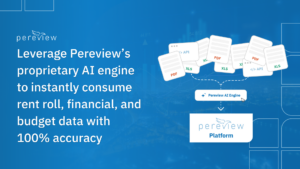
Our second promise: 100% data accuracy, 100% of the time. No one in this industry can afford to lose confidence in the numbers behind an Investment Committee memo or a quarterly report. I’ve had more conversations than I can count this year with customers who tell me some version of the same story — they asked a general-purpose AI tool a question they already knew the answer to, and it came back wrong. And that’s not a flaw that’s going away anytime soon. Structurally, large language models are text predictors, and they will hallucinate. So, if Pereview uses LLM technology too, how do we deliver on 100% accuracy?
Here’s how. We treat AI as one piece of a larger system, not the whole system. We use it for what it’s genuinely good at — extracting data from unstructured documents — and we pair that with application logic that validates the results, plus a human-in-the-loop review process when needed. Once the data is extracted, it goes into structured database tables, where it can be queried, searched, and reported on consistently and reliably, without ever getting re-run through a system that might phrase the same answer differently — or wrongly — the next time. That’s the approach our industry demands. And it’s the one we’ve built.
Responsible uses of AI in Pereview’s asset management platform
We use AI to reliably extract information from asset-level financials and rent roll files, commercial leases, financing agreements, and many other core document types. We then use those results to build a structured, quarriable dataset that supports natural language search.
This approach keeps AI efficient and safe, while making sure clients retain full ownership and control of their data and their alpha. To learn more about how you can modernize asset management for your firm, reach out to our team — we’d love to show you what’s possible with Pereview.
That’s the power of Pereview. Reach out to us at pereviewsoftware.com to learn more about how we’re putting these principles to work. Thanks for your time.
— Jeff Wilson, Founder & CEO, Pereview Software
Sources
- Karp, A. CNBC interview, 2026.
- Sacks, D. All-In Podcast, discussion of Anthropic, Figma, and Claude Design, 2026.
- The Information. (2026, June 12). “Anthropic Blindsides Its Business Partners.”
- Gurman, M. (2026, July 10). Bloomberg. “Apple Sues OpenAI for Trade Secret Theft Over AI Hardware Designs.”
- Chan, K. (2026, July 10). 9to5Mac. “Apple Sues OpenAI, Accuses Ex-Employees of Stealing Trade Secrets.”
It means retaining control of your data and your alpha, rather than handing broad access to a frontier AI lab. Real safety isn’t about content filters — it’s about who owns the data, who can train on it, and who has an incentive to build a competing product in your category.
These labs are positioned to see exactly which use cases work on top of their models, then launch a competing product in that category — as happened with Anthropic and Figma. For a real estate investment firm, that means leases, rent rolls, and financial data could end up shaping a tool built to compete in your own market.
No. Pereview has never sold customer data and does not use it to train its proprietary AI model. Customers retain full ownership, and any participation in the development process is opt-in, with active consent — a commitment that predates the current AI era by more than a decade.
Pereview treats AI as one piece of a larger system, not the whole system. AI extracts data from unstructured documents, application logic validates the results, and a human-in-the-loop review process checks the output before it feeds into reporting or decision-making.
It goes into structured database tables, where it can be queried, searched, and reported on consistently and reliably — rather than staying inside an AI model’s probabilistic memory, where the same question could produce a different, or wrong, answer each time.