

The Investment Thesis
| The Spring 2026 NAIOP CRE Sentiment Index came in at 52. That is still above the neutral 50 threshold, which means the industry broadly expects conditions to improve over the next 12 months. But it is a notable decline from 56 last fall. And the reasons behind the drop tell a more important story than the number itself. |
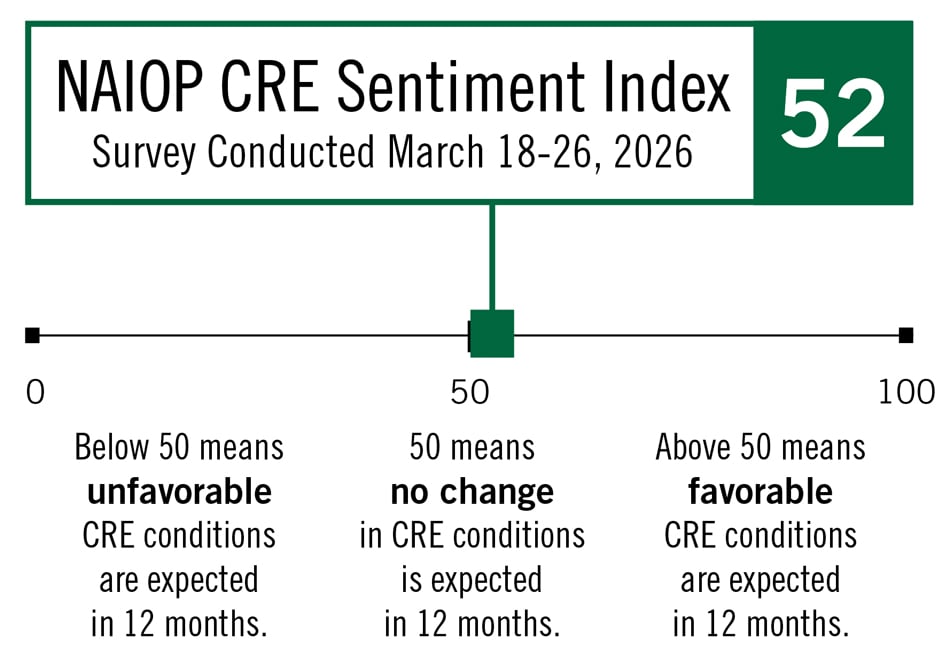 Source: NAIOP CRE Sentiment Index, Spring 2026 | Published April 23, 2026 |
Construction material and labor costs are climbing faster than respondents expected. Permitting delays are stretching timelines. Infrastructure constraints — including, increasingly, power availability — are narrowing the field of viable projects. The 266 CRE professionals surveyed across 237 firms paint a picture of an industry that is still moving forward, but with more discipline about where and how it deploys capital.
Fewer Projects Pencil. That Changes Everything.
When the cost environment tightens, the math on new development gets harder. Fewer projects pencil, and the ones that do need to be underwritten with greater precision. That is exactly what the NAIOP data reflects. Respondents expect capital market conditions to continue improving, but at a slower pace. They still anticipate higher occupancy rates, rent growth, and increased transaction volume. Industrial and multifamily remain the sectors drawing the most activity, followed by data centers and retail.
But the tone has shifted.
NAIOP CEO Marc Selvitelli captured it well: elevated costs are driving greater discipline across the industry. Developers are becoming more focused and strategic about what gets built. That is not a retreat. It is a recalibration.
Discipline Is Not Just About What Gets Built
This is where the conversation typically stops — at the development pipeline. But the discipline the industry needs extends well beyond site selection and construction budgets. It extends into how firms manage the assets they already own.
| When margins compress and fewer projects move forward, the existing portfolio becomes the primary driver of returns. That means reporting needs to be faster. Performance data needs to be cleaner. Investment committees need insight they can act on, not spreadsheets they have to assemble. |

|
The firms that thrive in a cost-constrained environment are the ones that have already solved the data problem — centralized information, standardized definitions, and reporting workflows that do not depend on manual assembly from disconnected systems.
That is the less visible but equally consequential form of discipline the NAIOP data implies. The industry is not just being more selective about what it builds. It is being forced to be more rigorous about how it manages what it has.
What Comes Next
In Part 2 of this series, we look at how institutional investors are responding to this environment — not by waiting for conditions to improve, but by demanding better data from the managers they invest with. A new LP-led initiative called REDI is attempting to standardize real estate reporting across the industry. The reason it exists tells you everything about where the pressure is coming from.
Subscribe Now